
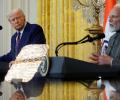
'But I don't think the government is in a great hurry to sign the BTA.'

'We don't have to compete with Maharashtra or Gujarat. We have to now start thinking about how we compete with the United States or China.'

Prime Minister Narendra Modi urged CEOs of US majors to take advantage of India's growth story as the country is making all efforts to become the third largest economy of the world in his third term. India is currently the fifth largest economy of the world after the US, China, Germany and Japan with a GDP of around $3.9 trillion. India has been the fastest growing large economies of the world with GDP growth rate of over 7 per cent for the last three consecutive years.

"India is the best market right now in the world with the digital initiatives the government has implemented
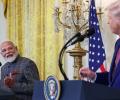
Of Trump's reciprocal tariffs and trade deals
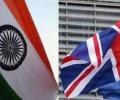
Negotiations for a trade deal between India and the UK have run into fresh controversy, after the proposals under a leaked chapter of the deal on intellectual property (IP) are believed to put access to affordable, lifesaving generic medicines from India at risk. According to the draft IP chapter put out by an international trade portal bilaterals.org, the UK is seeking continuous extension of patent period and rights through small tweaks in the drug, known as evergreening. This may prevent patents from expiring, impacting cheaper drug availability and its production by Indian generic drug manufacturers.

India had been engaged in a contentious battle with the US over the issue, especially in the pharmaceutical sector.

Prime Minister Narendra Modi on Thursday called for reforming the World Health Organisation and streamlining its approval process for vaccines and therapeutics, and favoured making flexible the WTO's rules relating to trade-related aspects of intellectual property rights.

Indian cos or academic institutions accounted for only 1,394 patent cooperation treaty applications
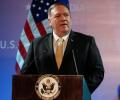
The United States, he said, 'desires a new age of ambition' in its relationship with India. Asserting that the US has never been more supportive of India's security, he said New Delhi too, is an important partner and a key pillar of President Trump's foreign policy.

Indian medicine accounted for over 50 per cent of all drug seizures in Europe for intellectual property rights violation last year. Industry experts said this indicates the seriousness of the problem. This data was revealed in the recently-released 2009 report of the European Union on the customs enforcement activities of its member states.

'If Indians are as smart as their counterparts in university, and have equal opportunity, then what is the reason that we cannot produce inventions of quality that are recognised by the world?'
An Indian pharmaceutical company is gearing up to sell a cheap version of the leading patented antiviral flu drug Tamiflu to emerging economies, in a move that will pitch intellectual property rights against affordable access to medicines.
After reports claimed that filings in patent offices in India, the US, and Europe did not mention ICMR or its scientists, but only BBIL and its scientists, the Hyderabad-based biotechnology (biotech) company clarified that in the "rush" to develop vaccines and file appropriate patents, BBIL had missed adding ICMR's name in the original filings.
In a significant development, Asian economic giants India and China have decided to coordinate positions on contentious trade and investment issues like agriculture, Trade Related Intellectual Property Rights and public health and investment.
The government of Switzerland will not be taking up the allegation by Novartis that Indian patent law is incompatible with the Trade-Related Aspects of Intellectual Property Rights agreement at the dispute settlement board of the WTO.

Bolton said that the arguments for China joining the World Trade Organisation was that it would become a more market-oriented rules-based society.
Cancun appears headed for a fiasco like Seattle with Tokyo World Trade Organisation mini-ministerial hitting roadblocks.
India on Wednesday maintained that its laws were compliant with the trade related intellectual property rights, dismissing the United States concern over New Delhi's "reluctance" to adopt TRIPS compliant patent law.

The United States 'is leading the world in the use of compulsory licenses, and is hypocritical in voicing indignance when developing countries issue compulsory licenses for essential drugs,' Washington-based Knowledge Ecology International, with its offices in Geneva, has alleged.
Federation of Indian Chambers of Commerce and Industry on Wednesday asked the US to restore the Generalised System of Preferences for Indian exports of chemicals and allied products.\n\n\n\n

So vaccinate employees and families, staff at home, rickshaw drivers, milkmen, service providers, shopkeepers and street vendors, says Naushad Forbes.

While India ranks 60, Switzerland, Sweden, the Netherlands, the US and UK retained their top spots as the most-innovative countries. China is at 22nd spot.

'We have often heard the mythical argument that patents block access to life-saving drugs, but only 5% of medicines from multinational companies are under patent protection in India.' 'Where these patented products are beyond the reach of Indian patients, the companies have programmes to facilitate access to their drugs, for free or for a fraction of the price,' points out Ranjana Smetacek, former director general, Organisation of Pharmaceutical Producers of India.

Top executives of American pharma companies favour "dialogue" with India and "not confrontation" to address their concerns on key issues like the protection of intellectual property (IP) and clinical trials.

'Today, let us reaffirm our commitment to strive to realise Gandhiji's dreams. His watchwords, truth and nonviolence, will continue to remain relevant for the whole world. He also taught us that rights and duties are but the two sides of the coin - indeed, the true source of rights is duty. Today we recall his lessons in compassion too - compassion not only for our human neighbours but also for our other neighbours, namely, flora and fauna, rivers and mountains.'

The US on Thursday raised concerns over India's Personal Data Protection (PDP) Bill and draft non-personal data governance framework, claiming these could potentially threaten innovation and economic growth. In its latest 'Special 301' Report, the US Trade Representative (USTR) kept India on the priority watch list, maintaining the country remains one of the world's most challenging major economies with respect to protection and enforcement of intellectual property (IP). In December 2021, a joint parliamentary committee released a report recommending changes to the PDP Bill, 2019, that could undermine important IP protections in India.

Ahead of his India visit on February 24-25, Trump said that India has not treated his country 'very well' on the trade front and indicated that a 'very big' bilateral deal with New Delhi may not be signed before the American presidential election in November.
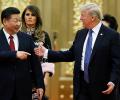
'What matters is that India's perspective on global issues -- climate change, intellectual property, free trade, trade routes being kept free, digital technology -- are listened to with respect,' says Ambassador B S Prakash.

The five-nation grouping BRICS on Tuesday resolved to combat terrorism in all its forms and manifestations, including the cross-border movement of terrorists, and vowed to step up joint efforts in building support for an India-backed global framework to effectively deal with the menace.

Donald Trump said he will never sign any trade agreement that hurts US workers, or diminishes its freedom and independence.

More and more women are making their presence felt in jobs related to sciences, technology, and engineering across organisations.
The council resisted intense pressure from the powerful manufacturing, pharma and other trade lobbies that have urged the Obama administration to enact punitive measures against India for a laundry list of alleged intellectual property and patent violations.
